Xero

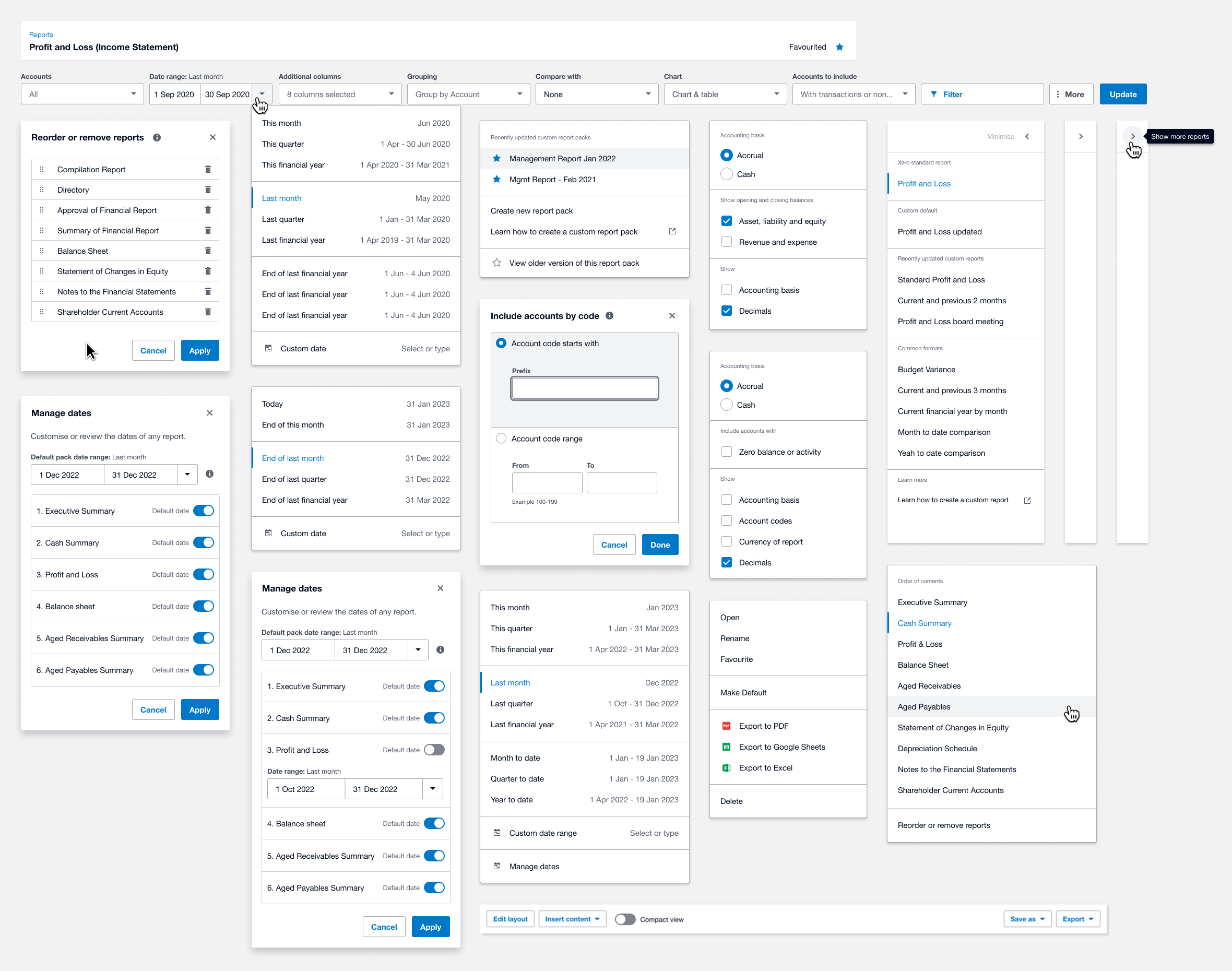
Reporting is one of Xero’s most used and business-critical product areas. Designing for Reporting meant working at scale where even small changes could impact millions of reports. Every change carried risk.


- 1M+ monthly active reporting users
- 8M+ reports run every month
- 30%+ of total Xero sessions
- 70+ reporting improvements delivered
Role: Senior Product Designer
Skills: Product design, UX, discovery, research, interaction design, prototyping, usability testing, accessibility, systems thinking
Company: Xero
Case study: Reporting Charts
Case study: Modern Reporting experience
At Xero, I worked as a Senior Product Designer on Reporting, helping evolve one of the company’s most-used and most business-critical product areas. Reporting was used by more than 1 million monthly active users, generated over 8 million sessions a month, and made up more than 30% of all feature sessions at Xero.
I contributed to 70+ Reporting releases, from incremental improvements to larger strategic initiatives. My work ranged from framing customer problems through to shaping interaction design, information hierarchy, usability, experimentation, and system consistency, helping small businesses and their advisors understand financial performance faster and with more confidence.
Although many of the interfaces were table-based, the work itself was deeply product- and systems-focused. I contributed across detailed customer-facing improvements and broader strategic initiatives, including Reporting Charts and the migration from legacy V1 reports to a more scalable modern Reporting experience, helping improve clarity, consistency, and value at scale.
Beyond Reporting, I also contributed to Timesheets and Payroll, and supported other product areas with reporting expertise.
 A best-in-class platform empowering small businesses and advisers to thrive with beautiful, easy-to-use reports and trustworthy, actionable insights that simplify compliance and foster seamless collaboration.
Xero Reporting
Opportunity: Reporting was one of Xero’s most business-critical product areas, used at scale by small businesses and advisors. The opportunity was to evolve it into a stronger, more scalable framework that could support global growth, diverse customer needs, and long-term product evolution, while reducing reliance on costly legacy systems.
Challenge: Reporting was a complex ecosystem of workflows, requirements, and user needs across both legacy and modern platforms. The biggest challenge was helping transition customers from V1 to V2: balancing the business need to retire the legacy system with strong customer attachment to familiar features and customisation. The work required improving clarity, consistency, and usability without compromising the trust and depth expected of financial reporting.
Leadership: I worked across 70+ Reporting releases, contributing through product thinking, systems thinking, UX, UI, interaction design, validation, and delivery. I collaborated across teams to refine the Reporting framework, adapt legacy experiences into the modern system, and shape solutions through rapid, research-led design loops. This included helping drive feature parity, designing new capabilities, and contributing to a smoother migration experience from V1 to V2.
Impact: This work helped make Reporting more coherent, scalable, and future-ready, while creating the foundation for major initiatives including Reporting Charts and V1 Exit. The V1 to V2 transition turned a high-risk customer pain point into a successful migration, with 17.8 million reports run in the first week after shutdown, only 91 sentiment feedback items, and daily usage by 267k organisations.
 User-centric research defined business-owner vs accountant tasks—informing UI flows that streamline daily operations and compliance, boosting clarity, confidence, and efficiency for both user types.
- Collaborate with cross functional teams to ensure proposed solutions balance user needs, business strategy and technical constraints
- Collaborate with development teams during sprints to provide design QA and problem solve issues as they arise
- Iterative design approach
- Daily WIPs and regular presentations to the key stakeholders
- Advocate for design and cross-functional collaboration
- Conduct research and analysis (competitors, trends, strategy, constraints)
- Define and frame design problems and vision
- Create design frameworks, wireframes, and models
- Explore and design innovative, user-centered solutions
- Prototype and test design concepts
- Collaborate with designers, accessibility and content specialists
- Design detailed, context-aware interfaces
- Communicate designs clearly to stakeholders
- Deliver thorough design specifications and handover materials to support the go to market teams
- Reporting charting framework and generative AI research
- Modernising the Reporting framework, accessible enhancements, greater flexibility and control
- Generative AI across Reporting and Insights design and research projects
- Participated in multiple Xero hackathons that solved key Xero feature requests for Reporting and across the product
- Reporting accessibility and supporting tools, keyboard hotkeys
- Mentored a Xero Design Grad in 2024 in Reporting and Insights team
- Senior Product Designer
- Senior Product Manager
- Business and Data analysts
- Engineering pods
- Accessibility and Content Specialists
- Go to market team
- Design team peers
Designing for small business owners meant turning financial complexity into more intuitive reporting, using familiar standard reports, common formats, and management reports that made performance easier to review and share, and businesses easier to run.
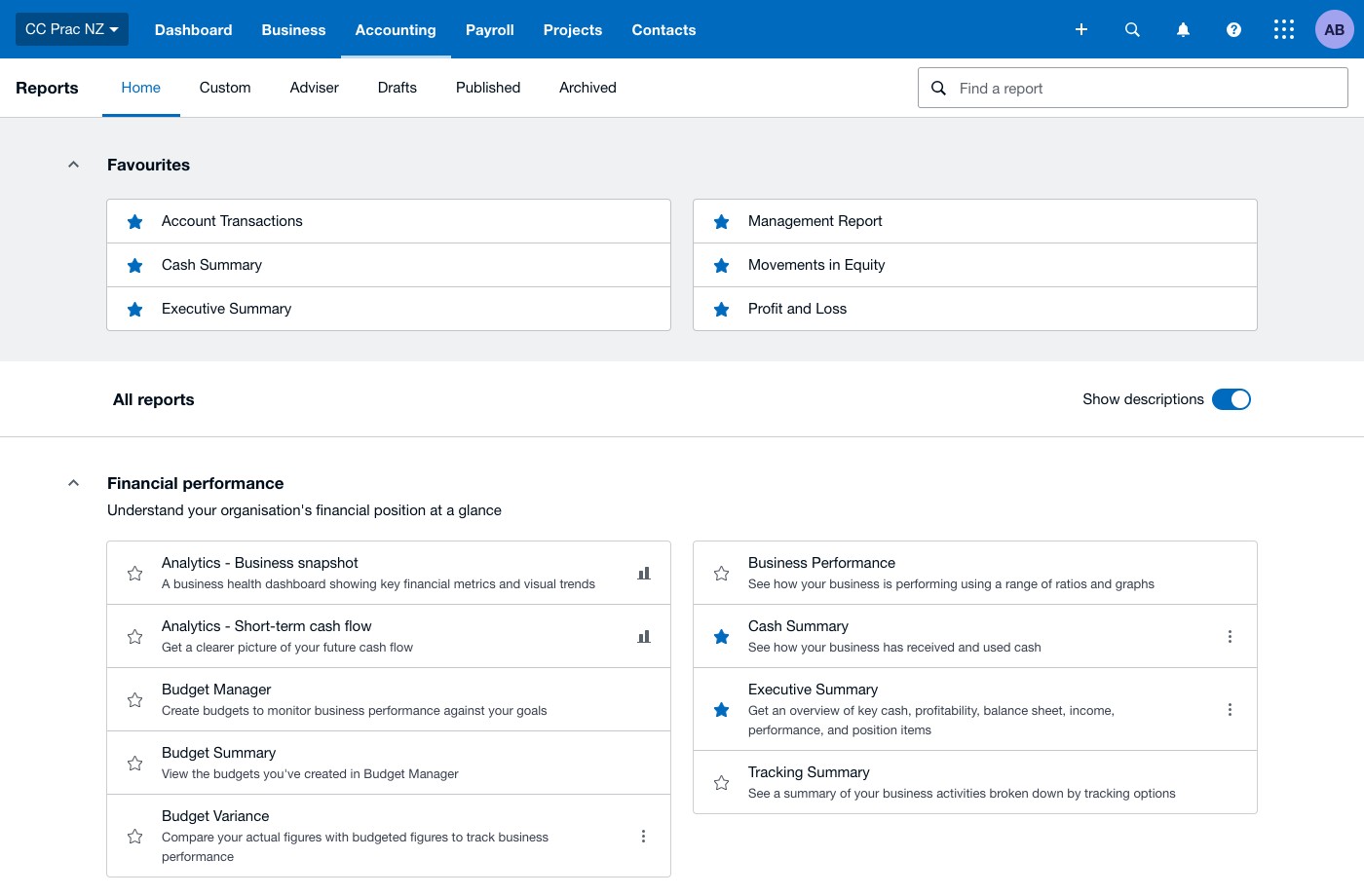 The Reports home organises reports into clear categories, with optional descriptions to help small business owners choose the right report, and favourites that make frequent reports faster to access.
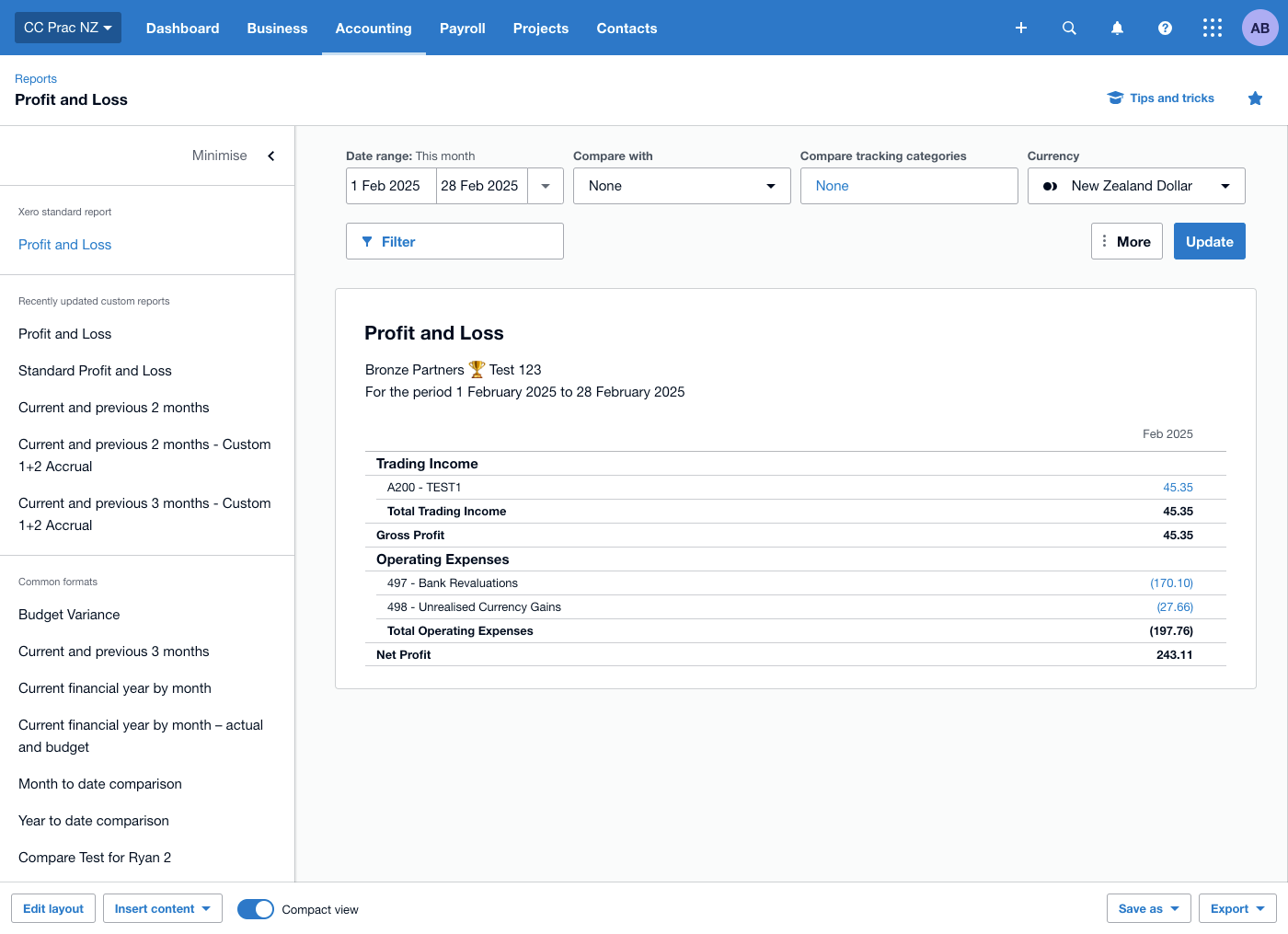 Popular reports like Profit and Loss bring together smart defaults, intuitive settings, and common preset formats, helping small business owners review performance quickly in the layout that best fits their needs.
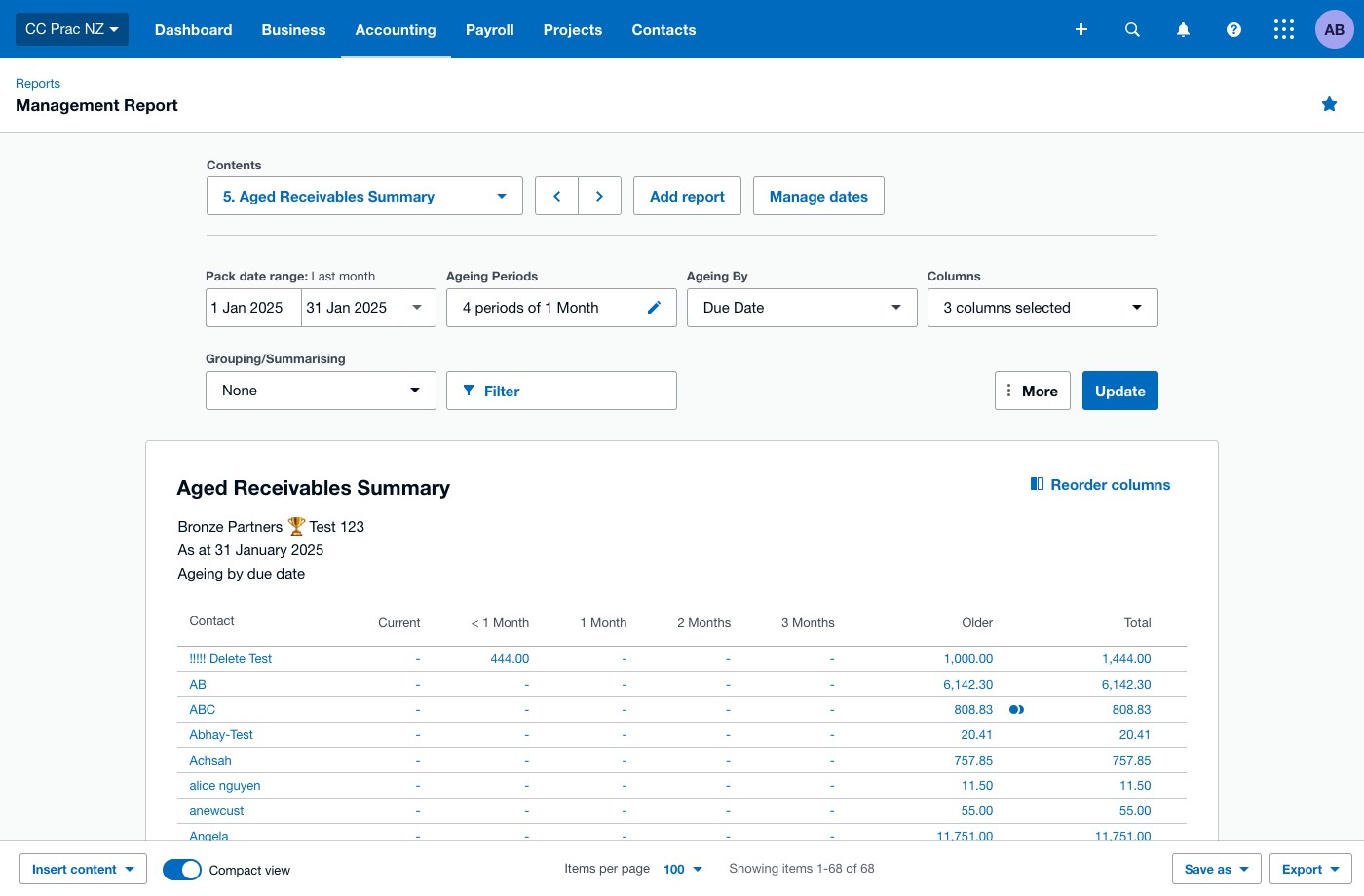 Management Report combines key reports into one flexible pack, with notes, presentation controls, and Manage dates, making it easier for small business owners to review performance, customise what they share, and present a clearer picture of the business.
Designing for advanced reporting users meant understanding the complex needs of accountants, advisors, and practices globally, then translating deep reporting workflows into tools that made client work more consistent, flexible, and efficient.
 Report styles give accounting practices a faster way to produce consistent, branded client reports by standardising layouts, reusable templates, and presentation across engagements.
 The standard report view supports most customers, particularly small business owners, while the layout editor gives accountants and advanced users extra flexibility to customise structure, formatting, and final output.
 Demo: Live PDF preview lets customers see changes instantly, making it easier to refine layout, formatting, and content before exporting or sharing.
 Hierarchical report layout editor with live PDF preview, custom groups, columns, formulas, schedules, and notes, helping customers customise reports faster while maintaining clarity, structure, and polished outputs.
 UX-designed journeys clarified personal vs. organisation-wide layout workflows, letting customers create, save, and apply custom report templates with governance. Improving efficiency, consistency, and control.
 UX-mapped end-to-end reporting and setup workflows. Defining nav, templates, and sharing steps, to streamline report creation, customization, and distribution, boosting customer efficiency and governance.
Other projects
I worked on a wide range of digital projects that included B2C and B2B applications across web and native app platforms. I was involved in all levels of product design and development from research to implementation.
Responsible for UX, Product and UI design, including improvements on existing applications and new product development. Assisting in gathering requirements to adapt products from legacy systems into the new framework and design rationale.